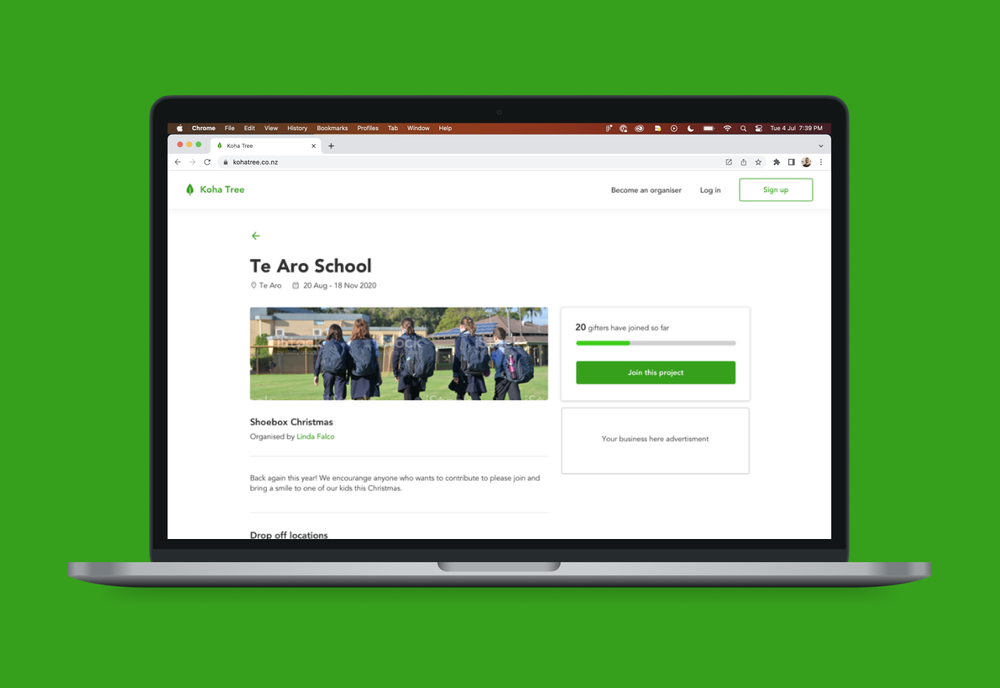
Creating a scalable community platform for a national non-profit
Snapshot
Role: Principal Product Designer
Product: Koha Tree web platform
Timeline: 1 year
Impact: 180 community projects on the platform at launch
Context & Problem
Koha Tree is the evolution of Shoebox Christmas, a volunteer-led non-profit that delivers donated Christmas gifts to children across New Zealand.
Over nine years, Shoebox Christmas grew from a small Wellington initiative into a nationwide operation — but behind the scenes, it relied heavily on manual coordination by the founder and a small group of volunteers.
I led the end-to-end design of a scalable web platform that transformed Shoebox Christmas into Koha Tree: a self-service, user-generated ecosystem that empowers communities to create, manage, and participate in local giving projects beyond Christmas.
The Challenge
Shoebox Christmas had outgrown its original operating model.
Schools and community organisations relied on volunteers to manually manage projects
Gift matching, communications, and changes to children’s details required ongoing intervention
The model worked for one seasonal campaign, but could not scale beyond it
The ambition was not just to improve Shoebox Christmas — but to create a platform that could support any community-led initiative, such as food drives, winter coat collections, or emergency relief efforts.
The core challenge:
How might we design a platform that allows people to both participate in and organise community projects, while reducing operational burden and enabling long-term scale?
My Role & Team
I worked as the Principal Designer, owning:
Product and platform UX
Information architecture
Design system foundations
Brand and identity
The core team consisted of:
5 developers
Product Owner / Business Analyst (founder)
Illustrator / animator
We designed and built the pilot as a responsive web platform using React, prioritising accessibility for schools and organisers. Mobile native apps were intentionally deferred in favour of establishing a strong, flexible web foundation.
Discovery & Strategic Framing
Understanding the current system
I began with deep discovery sessions with the founder and long-term volunteers to map:
Existing workflows
Operational pain points
Assumptions embedded in the manual process
This highlighted a key insight:
The platform needed to support two equally important roles — contributors and organisers — often embodied by the same person.
Learning from scalable marketplaces
To inform the platform model, I studied systems that successfully manage two-sided participation:
Airbnb / Uber — enabling users to both consume and provide value
GoFundMe — representing causes, calls to action, and community impact
Mailchimp — managing time-based communication and segmented messaging
These patterns helped shape the mental model for Koha Tree as a community marketplace, not just a campaign website.
Platform designs
Information Architecture
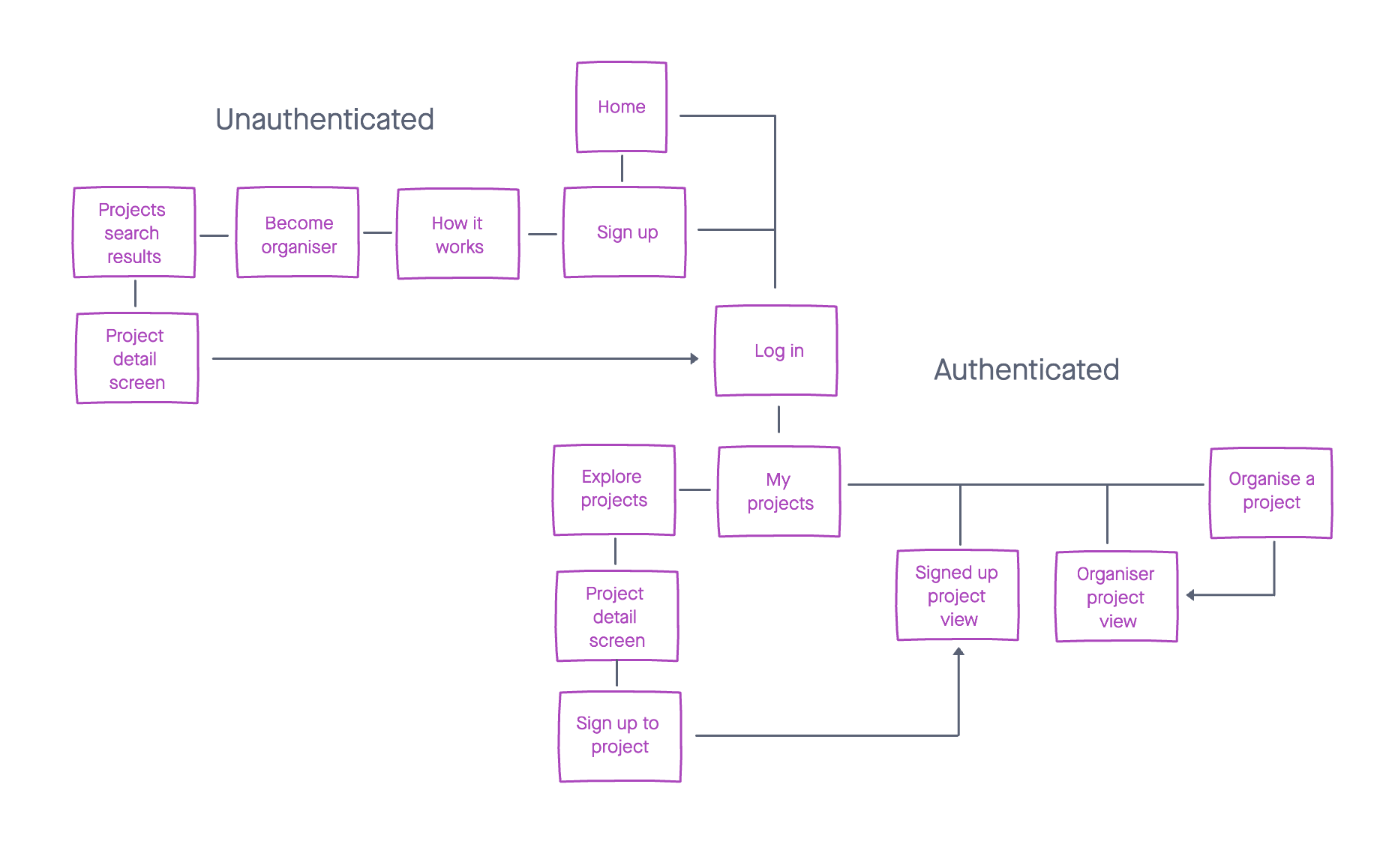
A key early decision was to separate the experience into:
An unauthenticated front door for discovering projects
An authenticated platform for managing participation and organisation
This allowed people to explore local projects before committing, while supporting complex project management once signed in.
Core User Flows
I designed and tested flows for:
Creating an account and onboarding
Discovering and joining local projects
Organising a project end-to-end
Managing communications, timelines, and participant updates
Usability Testing
Remote usability sessions were conducted with existing Shoebox Christmas organisers and volunteers.
Key learnings:
Users needed a single dashboard showing both projects they joined and projects they organised
Project timelines required multiple milestones, not just start and end dates
Organisers needed to preview how their project appeared publicly
Messaging needed to support multiple, scheduled touchpoints
Children’s details frequently changed after projects began — the system needed to accommodate this without friction
These insights directly informed the platform structure and feature prioritisation.
Identity & Design System
I designed the Koha Tree identity alongside the product experience.
Green was chosen to represent growth, renewal, and community
The logo was intentionally simple, designed to retain recognition at small scales
The visual language balanced warmth and trust with functional clarity
In parallel, I established a foundational design system, prioritising the components and patterns required to support development while leaving room for future scale.
Final Experience
The final platform enables:
Community organisations to create and manage projects independently
Participants to discover, join, and contribute to local initiatives
Ongoing communication and updates without manual intervention
The experience was designed to scale across different project types, timeframes, and levels of complexity, setting Koha Tree up as a long-term community platform rather than a single-purpose tool.
View the Koha Tree platform
Results
The platform launched earlier than planned in response to severe flooding in New Zealand, enabling immediate community relief.
At launch:
85
flood relief projects created nationally
75
Shoebox Christmas projects running on the platform
Koha Tree is now actively supporting multiple community initiatives through a single, scalable system.
View the Koha Tree platform
Reflections
Designed for constraint
With limited time, budget, and volunteer capacity, focusing on strong foundations allowed the platform to evolve incrementally without stalling progress.
Bias for action
Close collaboration with experienced organisers enabled confident decision-making, with flexibility to adapt as the platform was used in the real world.
End-to-end ownership
Owning both the product experience and the identity allowed for a cohesive, intentional platform that aligns purpose, usability, and scale.